StatesofSelfIntroductionText
A-Z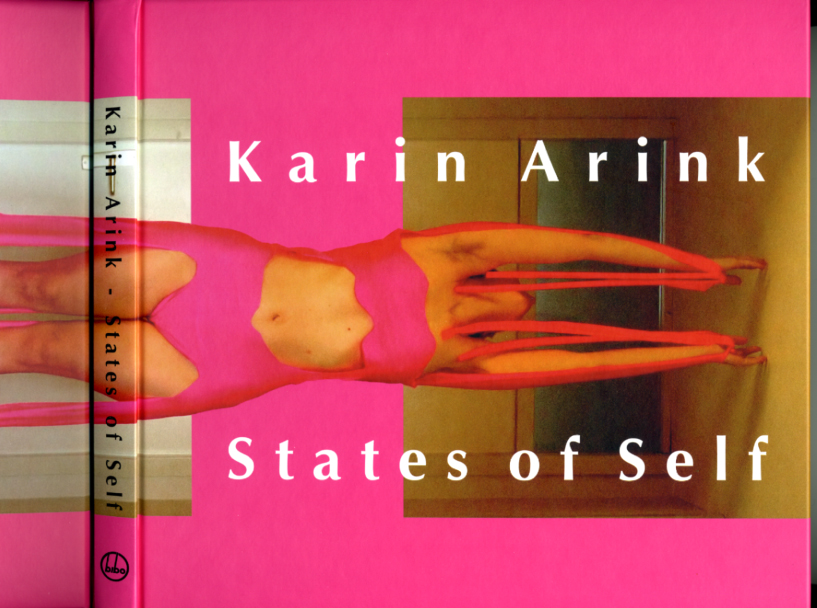
‘Karin Arink - States of Self’ monograph 2008
published on the occasion of my solo ‘Karin Arink - States of Self’ in Stedelijk Museum Schiedam 2008, with generous support of Fonds BKVB (now Mondriaan Fonds), Galerie Tanya Rumpff, Stedelijk Museum Schiedam
made in close collaboration with friend, artist and graphic designer Bibo
this book is structured into 7 chapters based on the psycho-social model of Engel (1980)
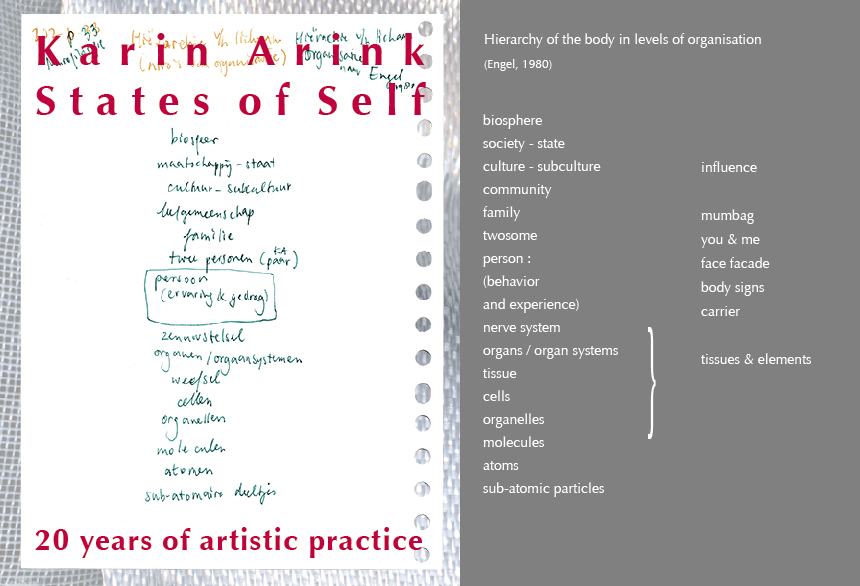
these chapters were ‘states of self’ ranging from the microscopic inside an organism (tissues & elements) to the body-as-posture (carrier) to the body-as-sign (sign) to the body as interface between me and the other (face facade) to me in relation to you (you&me) to the relations within a family (mumbag) to me in relation to bigger structures (influence)
as you can see these same were used as one of the navigations through this website as well…
each spread shows 1 key work on the right hand page, combined with related works - non-chronologically ordered - and/or with sketches of the work…
the introduction text is written by me, the book also has texts on my work by Anne Berk, Petra Else Jekel and Wilma Sütö on my work
here the full Introduction text as written by me:
Introduction for ‘Karin Arink – States of Self’ 2008*
by
Karin Arink
Welcome in this book! Initiated and compiled by me, States of Self aims to present the coherence and width of almost twenty years of artistic practice to you.
My works are metaphors of the ways in which a person exists in relation to others. I believe this interrelation is multi-layered and complex: (in)formed by the ways in which society views and values individuality, by the ways people around me reacted and react to my behaviour, to ‘me’.
I am never sure that any external observer can see exactly who I am; and neither can I be sure that the ways in which I view myself represent who I really am. The ‘I’ is a changing, shifting bundle of influences, of blind spots and preferences, easily misled by preconceptions from the outside or the inside.
If we would have met in the flesh, a split second would have been enough to make us gauge each other: a glance at your countenance, your posture, your clothes, your movements, a whiff of your scent, a brief exchange of words…
And through your reaction to my words, my looks, my behaviour, you would subtly enforce or counter certain ideas I might have about ‘me’. Or is it my perception of your reactions that is changing ‘me’…? To remain sane, we need some unity of view with others, and thus, over the years, people change each other, and I change ‘me’.
When I reflect upon the interaction with you (& you & you & you), I am fascinated by the way the body reacts to these different fictions of self, these emotions, and vice versa; by the ways interior and exterior are interrelated, and by the role of communication. Communication makes us play out our roles, makes us test our positions and assumptions, makes us exist and change in exchange, creating new states of self all the time.
I make work to communicate with you in a non-discursive, non-literal way.
To show a thought, the body, its posture, or appearance, in its effect on a specific state of self, I break down the preconceptions we have of them. I fragment and recombine words, I hollow out the mass of flesh, I narrow or multiply the number of limbs, I cut the surface of dress, of skin and of the image itself. This way, an image can become a metaphor, conveying a ‘what-if’ hypothesis about a certain state of self, which, in turn, enables new interchanges between you (the observer) and me (the maker).
And as these interactions are acted out in different ways, my ideas are materialised in a wide variety of media: life-size cut photographs, modelled, cut or stitched sculptures, drawings and cuts of (adhesive) foil, computer animations and text works.
This book is a means to map my works.
In States of Self, the works are ordered in 7 Chapters, seven ‘states of self’.
These are based on (my adaptation of) the bio-psycho-social model described by G.L. Engel in 1980: ‘Hierarchy of the body in levels of organization’. [See the note I made in 2007, when I stumbled across this diagram in the book ‘Neurofilosofie’ by J.A. de Boer, which I had borrowed from my friend Liorah Hoek.] The gradual continuum of this diagram, stretching from elementary physics, through biology, the personal and to the social appealed to me, and I could instantly see its relevance to my states of self. As my work zooms in on some levels while ignoring others, I formulated my version: 1. tissues & elements; 2. postures; 3. signs; 4. appearances; 5. couples; 6. family; and 7. communities.
Of course, states of self are never so clear-cut as to be always neatly covered by one description, and neither can my works. In some works, the concept was decidedly ‘you and me’ whereas in the final work the ‘body elements’ are more present. In others, multiple states are activated. On the whole, the book States of Self groups works according to the final result offered to the spectator.
To present my work, I have invited my friend Bibo to develop the structure of the book. Bibo is an artist-observer who specializes in structuring visual and textual information by means of graphic design, in order to map the often unconscious systems people make in their actions and situations. Since 1989, she has been an (often invisible) contributor to many a project, both practically (doing the camera, helping with making the installations) and conceptually: a critical advisor reacting on form and content of my work, and allowing me to do the same to her work. Bibo has made the visual system, the design and her keen eye helped enormously in discerning which works should go where. In conjunction we have developed the concept, and done image selection and visual editing.
Recurrent in the book, marking the states of self, you will find enlarged details (scale 8:1) of my work, in order to allow a closer, more intimate examination.
On every right-hand page, you will find a key work, counterbalanced or enhanced by sketches, related works (sometimes also key works!), texts, images of context, etcetera, to show concept, process and visual result.
This meant going over my image archive with a fresh approach, looking not only for portfolio images but also for photos of works-in-progress, of works positioned, etcetera. The images’ sources vary widely: small and large slides of diverse quality, photographs shot with my traditional Nikon camera or my (already) old-generation digital camera, or, sometimes, by professional photographers… For visual unity, we used the expert hand of digital lithographer Marc Gijzen.
Combined with these images, you will find many scans from my notebook: a bundle of perforated pages containing ideas, sketches, notes and rants; an important archive of visual and textual ideas tracing the developments in my work.
As both text and image (in)form and influence states of self, you will find many texts - texts-as-work and texts circumscribing my work - placed adjacent to the images on every page, as equal partners.
I invited art critic Anne Berk, curator Wilma Sütö and art historian Petra Else Jekel to react to my work from their different positions.
In 1993, Wilma Sütö was one of the first to review my works in a major Dutch newspaper, De Volkskrant. In 1999, as ‘stadsconservator’ (city curator), she bought a group of works for the Stadscollectie (collection of Rotterdam-based artists) of Museum Boijmans van Beuningen, Rotterdam. And in 2000, she curated the international group show entitled ‘Exorcism/Aesthetic Terrorism’ in the same museum, in which a large selection of my works were shown. At the moment, she is head curator of the Stedelijk Museum Schiedam, and along with Nicole Theeuwes is currently organizing my retrospective ‘Karin Arink - States of Self’ there in summer 2008.
Anne Berk is a publicist and art critic. In 2004 she curated the ‘Bodytalk’ exhibition, showing my works alog with others’ who use the physical as a conceptual element. To accompany the exhibition, she published the book ‘Bodytalk’, with an in-depth study of the participating artists. At present, she is working on various projects, including ‘Searching for meaning’, which continues this research in an international context.
Petra Else Jekel graduated in Art History from the Rijksuniversiteit Groningen in 2007. She specialized in Modern and Contemporary Visual Art and Gender in Contemporary Art, with a thesis on the modelling of contemporary art practices in terms of concepts such as gender and difference. She also is the author of literary fiction and non-fiction, and works as a cultural advisor.
Karin Arink - States of Self offers multi-angled views on my work. The combination of texts, visual and textual works presents metaphors for different states of self that any person might experience. Human existence is multi-layered and not easy to map or convey, but I hope States of Self will be a means to perceive some (non-discursive) thoughts about being. And that my works can make you see and ponder some ‘alien’ states of self, however indirectly or temporarily.
Enjoy the book!
Karin Arink, 2008
- Colofon:
concept & editing
Karin Arink
Bibo
design
Bibo
photography
Karin Arink
or see captions on the page
lithography
Marc Gijzen
texts
Karin Arink, Anne Berk, Petra Else Jekel, Wilma Sütö
translation
George Hall
printing
Veenman Drukkers Rotterdam
ISBN/EAN: 978-90-8690-125-8
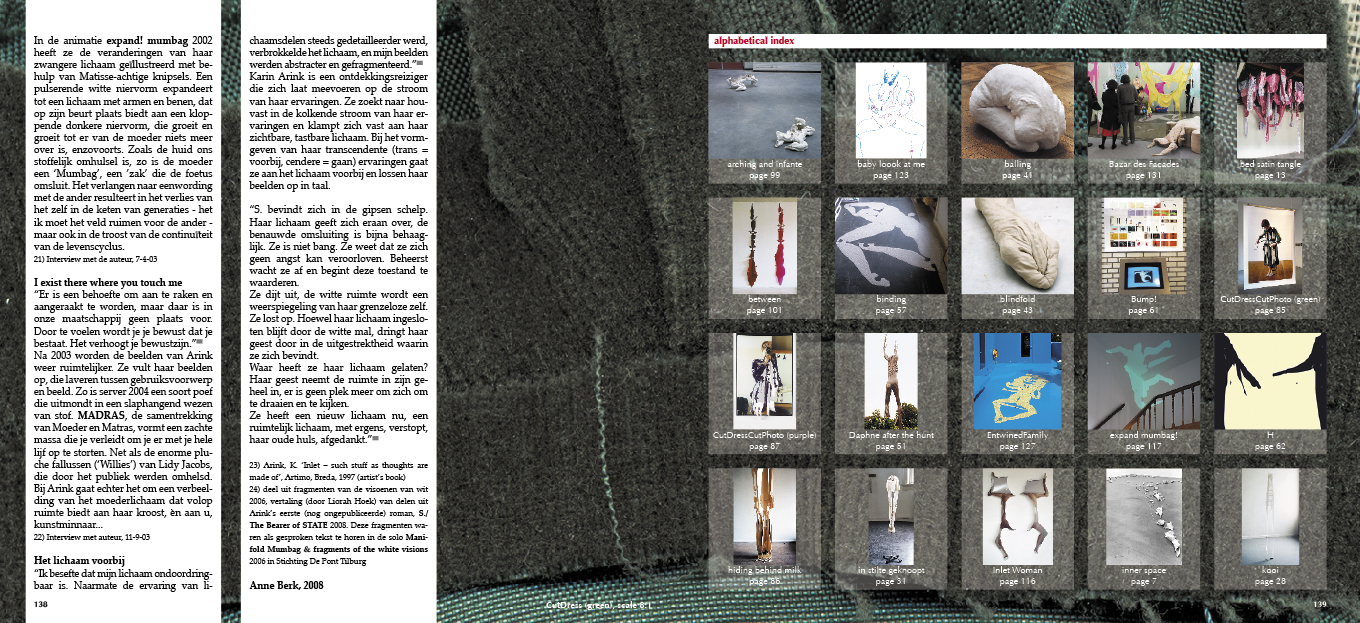 page 139 shows the end catalogue in this book
other publications: ‘Inlet - such stuff as thoughts are made of’ 1997 /
other solos: ‘Manifold Mumbag’ 2006 (satin) / ‘Kooi / Käfig’ solo 2013 / ‘All attitudes, …’ in Galerie RAM Rotterdam 2014 / in Club Solo 2016 /